

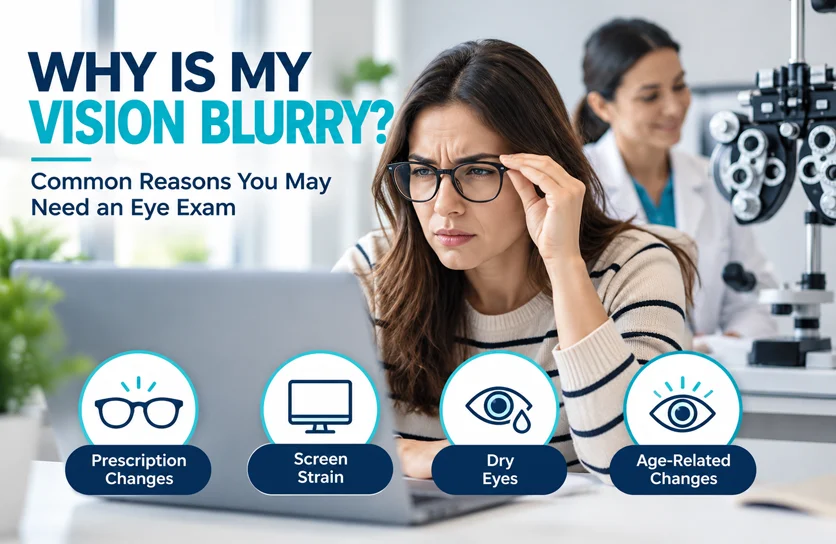
Blurry vision is one of the most common reasons people decide it’s finally time to have their eyes checked.
Sometimes the change is obvious. You suddenly realize road signs aren’t as sharp as they used to be, or the words on your computer screen seem slightly out of focus.
Other times, the change happens so gradually that you barely notice it.
You may start squinting, increasing the font size on your phone, sitting closer to the television, or holding a menu farther away. These small adjustments can become habits, and you may not realize your vision has changed until you have an eye exam.
So, why does vision become blurry—and when should you have your eyes checked?
Your Eyeglass Prescription May Have Changed
One of the most common explanations for blurry vision is a change in your prescription.
Nearsightedness, farsightedness and astigmatism can affect how clearly you see at different distances.
Even if you already wear glasses, your prescription may change over time.
Because prescription changes can happen gradually, you may continue wearing the same glasses without realizing that you’re no longer seeing as clearly as possible.
Some signs that your prescription may need to be updated include:
- Squinting to see distant objects
- Difficulty reading road signs
- Blurry text on screens
- Headaches after reading or computer work
- Tired eyes
- Difficulty switching focus between distances
An eye exam can determine whether your prescription has changed and whether updated eyewear may improve your vision.
Difficulty Reading After 40
If you’re over 40 and suddenly find yourself holding your phone or restaurant menu farther away, you’re certainly not alone.
A common age-related change called presbyopia gradually makes it more difficult for the eyes to focus on nearby objects.
You may notice that small print becomes more difficult to read, particularly in dim lighting.
At first, moving your phone farther away may solve the problem.
Eventually, however, your arms aren’t quite long enough.
Reading glasses, progressive lenses or other prescription options may help, depending on your individual vision needs.
Too Much Screen Time Can Affect Visual Comfort
Computers, smartphones and tablets are now part of everyday life.
Spending long periods concentrating on screens can contribute to tired eyes, dryness, headaches and temporary difficulty focusing.
You may notice that your computer looks blurry toward the end of the day or that it takes a moment for your eyes to refocus when you look across the room.
Taking regular breaks, adjusting your workstation and making sure your prescription is appropriate for your working distance can help improve visual comfort.
Persistent symptoms, however, shouldn’t simply be blamed on screen time. An eye examination can help determine whether something else may be contributing.
Dry Eyes Can Sometimes Make Vision Seem Blurry
Your tears help maintain a smooth surface over the front of your eyes.
When the eyes become dry or irritated, vision may temporarily fluctuate or appear blurry.
Some people notice that their vision becomes clearer immediately after blinking and then gradually becomes blurry again.
Dryness may be associated with environmental conditions, prolonged screen use and other factors.
If dry-eye symptoms continue, an eye care professional can evaluate your eyes and recommend appropriate management.
Cataracts Can Gradually Affect Vision
Cataracts occur when the natural lens inside the eye becomes cloudy.
They are more common as people get older and typically develop gradually.
People with cataracts may notice:
- Blurry or cloudy vision
- Increased glare
- Difficulty driving at night
- Halos around lights
- Colours appearing less vibrant
- Frequent prescription changes
Because cataracts often develop slowly, some people adapt without realizing how significantly their vision has changed.
A comprehensive eye examination can help determine whether cataracts or another eye condition may be affecting your sight.
Blurry Vision Isn’t Always Just About Glasses
It’s easy to assume that blurry vision automatically means you need a stronger prescription.
Sometimes that’s true.
But changes in vision can also be associated with eye-health conditions or other health issues.
That’s one reason comprehensive eye exams are important.
An eye examination evaluates more than your prescription. Your optometrist can also assess the health of your eyes and determine whether additional testing, treatment or referral is appropriate.
What About Blurry Vision in Only One Eye?
Changes affecting one eye can sometimes be harder to notice because the other eye may compensate.
You may continue functioning normally without realizing that one eye isn’t seeing as clearly as the other.
Try covering one eye and then the other while looking at the same object.
Does the image appear significantly different?
A difference doesn’t necessarily mean something serious is wrong, but a noticeable change is worth discussing with an eye care professional.
Don’t Ignore Sudden Vision Changes
Gradual changes should be evaluated, but sudden changes require particular attention.
Sudden loss of vision, significant new blurring, flashes of light, a sudden increase in floaters, a curtain or shadow across your vision, severe eye pain, or other abrupt visual symptoms should be assessed promptly.
Don’t wait for a routine eye appointment if you’re experiencing a sudden or significant change in your eyesight.
When Was Your Last Eye Exam?
One of the difficulties with eyesight is that you’re using the same eyes every day.
When changes occur gradually, you don’t have an obvious comparison.
An eye exam gives you that comparison.
Your current vision, prescription and eye health can be evaluated and, when previous records are available, changes can be monitored over time.
Even people who believe they see perfectly can benefit from routine eye care.
Making Eye Exams More Convenient
Busy schedules are one of the biggest reasons people postpone routine appointments.
Optician On Wheels helps make professional eye care more accessible by bringing mobile eye exams directly to homes, workplaces and communities across Toronto and the GTA.
Instead of putting off your eye exam because travelling to a clinic is inconvenient, the clinic can come to you.
Don’t Get Used to Blurry Vision
The biggest mistake isn’t necessarily noticing that your eyesight has changed.
It’s noticing the change and continuing to adapt to it.
Squinting, moving closer, increasing font sizes and avoiding nighttime driving can gradually become normal behaviours.
But your vision deserves better than simply learning to cope.
If things aren’t looking as clear as they once did, schedule an eye exam with Optician On Wheels.
Sometimes you don’t realize how much your vision has changed until you see clearly again.